If you have reached the point where individual fillings, crowns and extractions feel like patching a roof in a storm, All-on-4 dental implants offer a different proposition: replacing an entire arch of failing teeth with a fixed set anchored on four implants, often on the day of surgery. Patients across Toronto and North York who search for teeth in a day are usually picturing exactly that: walking out of a single appointment with teeth screwed into place rather than resting on the gums. What that phrase does not capture is the journey on either side of surgery day, and this article walks through the whole of it, using a real transformation from our own clinic to show what the process actually looks and feels like.
Key Takeaways
- The All-on-4 concept restores a full arch of teeth on four implants, with the back two placed at an angle so they anchor in denser bone, often avoiding the need for bone grafting.
- "Teeth in a day" refers to same-day function, not same-day healing. You leave with a fixed provisional bridge, but the implants still need several months to fuse with the bone before your final teeth are fitted.
- The journey has four stages: consultation and 3D planning, surgery day, the first healing weeks on a soft diet, and the fitting of the final prosthesis once the implants have integrated.
- Good candidates are people experiencing or already living with total tooth loss in an arch, including those whose remaining teeth are broken down by decay and gum disease, as shown below.
- Published outcomes for immediately loaded full-arch implants are strong, and most patients report a marked improvement in eating, appearance and confidence within months.
- The prosthesis is impervious to cavities, but the surrounding gums and implants still require daily cleaning and regular professional maintenance.
Find our Dental Clinic Near You
What "Teeth in a Day" Actually Means, and What It Does Not
The single biggest source of confusion around this procedure is the timeline, so it is worth settling before anything else. "Teeth in a day" is accurate about one thing and misleading about another. It is true that a patient can arrive in the morning with failing or missing teeth and leave the same afternoon with a full, fixed arch that looks like teeth and lets them smile immediately. It is not true that the whole treatment is finished that day.
What happens on surgery day is called immediate loading. The four implants are placed, and a temporary fixed bridge is attached to them straight away, so the patient never has to go home toothless or wear a removable denture during healing. Underneath that provisional bridge, the biology still takes its normal course. The implants need to osseointegrate, meaning the surrounding bone grows onto their surface and locks them in place, and that process unfolds over the following months rather than hours. Only once integration is confirmed is the temporary bridge replaced with the definitive, stronger prosthesis.
That distinction matters because it sets honest expectations, and the reassuring part is that immediate loading is not a shortcut that trades away reliability. A systematic review that pooled 34 studies and analyzed 5,349 immediately loaded implants, followed for an average of 6 years, reported a mean survival of 97.4 percent , with results in the lower jaw significantly better than in the upper jaw. In other words, the same-day approach that makes the procedure so appealing has a long track record, provided the case is planned and executed properly.
A Real All-on-4 Transformation at Our Clinic
Numbers and timelines only go so far. The clearest way to understand what this procedure does is to see it, so the two photographs below are from one of our own patients here at North York Smile Centre, shared with permission. They are not stock images or a manufacturer's brochure. They are the same person, before treatment and after, and together they capture the entire reason full-arch implants exist.
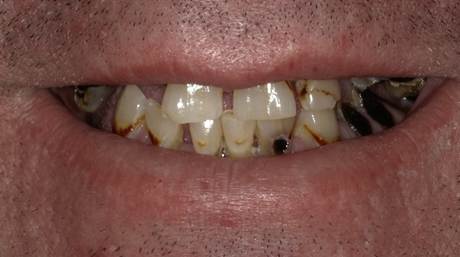
The first photograph shows the situation many patients are quietly living with long before they call us. The remaining teeth are heavily broken down, darkened by advanced decay, chipped and uneven, with visible gaps and dark caries at the gum line and failing older restorations toward the back. Teeth in this state are rarely just a cosmetic problem. They make chewing painful, harbour infection, shift and loosen, and, for most people, carry a daily weight of self-consciousness that quietly reshapes how they eat, speak and smile in front of others. This is the point at which piecemeal repair usually no longer makes sense, because each individual tooth is compromised and the arch as a whole is no longer serviceable.
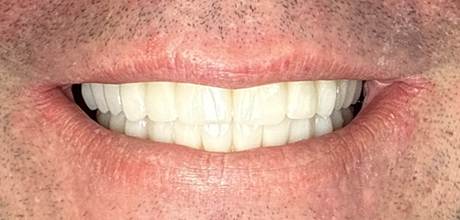
The second photograph shows the same mouth after full-arch rehabilitation. In place of the failing dentition, there is now a single, fixed arch of even, natural-looking teeth, secured on implants rather than sitting on the gums. The bite is restored, the midline is even, and the patient can eat and smile without hiding. What the image cannot show is the change in daily life that tends to accompany that visual result, which the research on this procedure describes clearly and which we see in our own patients.
As Dr. Jerry Jesin , who has practised cosmetic and implant dentistry for more than three decades, points out: "People assume a case like this is about appearance, but the real engineering problem is the foundation. When the remaining teeth are this compromised, we are not saving them; we are removing sources of infection and rebuilding a bite from four fixed points. The two posterior implants are deliberately tilted so they engage solid bone toward the front of the jaw, which spreads the load and very often lets us avoid grafting altogether. Getting those angles and that immediate bite right on the day of surgery is what determines whether the final result lasts for decades or merely looks good for a photograph."
That improvement in daily function is not merely anecdotal. In one study tracking patients through full-arch immediate-loading treatment, four months after surgery, 92 percent of patients no longer felt tense about their smile and 96 percent reported no problems relating to other people or smiling, alongside significant gains in chewing ability. The transformation in the photographs, in other words, is representative of what the procedure is designed to deliver, not an outlier.
The Journey, Step by Step
Understanding the four stages of treatment removes most of the anxiety that surrounds it, because almost every worry patients raise turns out to be about not knowing what comes next. The path from a failing arch to a finished smile is well defined, and while the exact schedule varies from person to person, the sequence rarely does.
The Consultation and 3D Planning
Everything begins with an assessment rather than surgery. At the first visit, the arch is examined, a full medical history is taken, and a three-dimensional cone beam scan maps the bone in detail, showing where it is dense enough to anchor implants and where it is thin. This is the stage where the treatment is actually designed: the position and angle of each implant are planned relative to the real anatomy, and the decision between an upper arch, a lower arch, or both is confirmed. It is also where alternatives are discussed honestly, since the same scan reveals whether a different implant configuration would serve better, and the planning is driven by your anatomy rather than a fixed template. That flexibility in the number and placement of implants is the idea behind the All-on-X approach, which is explained in the next section.
Surgery Day, Hour by Hour
Surgery day is long but far less dramatic than most people fear. Patients typically arrive in the morning and are settled with sedation appropriate to the case, so the hours pass without distress and often without much memory of them. Any remaining failing teeth in the arch are removed, the four implants are placed according to the plan, and impressions or scans are taken so the provisional bridge can be fitted the same day. By early afternoon, most patients are on their way home with a fixed set of teeth already in place. The procedure is done under local anesthetic with sedation rather than in a hospital, and the same-day fixed bridge is what separates this approach from older methods that left patients in removable dentures for months.
The First Healing Weeks
The early healing period demands the most of the patient and is primarily about protecting the new implants as the bone begins to grow around them. A soft diet is essential during these weeks because chewing hard or crunchy foods too early puts force on implants that have not yet integrated. Swelling and mild discomfort in the first days are normal and settle with the prescribed medication. Careful cleaning around the new bridge starts almost immediately, since keeping the surgical area clean is central to healing. Most people return to work within a few days, though the dietary restrictions continue for considerably longer while integration proceeds beneath the surface.
The Healing Months and the Final Teeth
Osseointegration is not something the patient can feel happening, but it is the part of the process that makes everything else durable. Over roughly three to six months, the bone fuses to the implant surfaces, and only once that is confirmed is the temporary bridge exchanged for the definitive prosthesis, which is stronger, refined in fit and appearance, and built to last. The material of that final bridge is itself a considered choice, and patients who want to understand the trade-offs can compare zirconia and titanium implant options before the final restoration is designed. This restoration is the one intended to serve for many years, and the moment it is fitted is when the treatment is genuinely complete. From that point, the relationship shifts from active treatment to long-term maintenance, which is where the durability of the result is won or lost.
From All-on-4 to All-on-X: Why the Number of Implants Is No Longer Fixed
It helps to understand how this treatment arrived where it is, because the history explains why the modern version is both better and more affordable. Years ago, replacing a full arch often meant eight to ten implants, bone grafting, multiple surgeries and long healing times. It was excellent treatment, but it was involved, slow and expensive. The arrival of All-on-4 was a breakthrough: by placing just four implants, with the back two angled to reach solid bone, many patients could receive fixed teeth the same day, and treatment became faster, more predictable, and more affordable.
All-on-X is the next step, and the "X" is deliberate. Rather than committing every patient to exactly four or exactly six implants, the approach lets the number and position be decided by the individual jaw, so a patient with more bone might be treated with four while another with a different anatomy receives more, each planned to the same standard. This is where a fully digital workflow changes the outcome in practical terms. At our clinic, every case is planned digitally from CBCT and intraoral scans taken with an iTero scanner; the smile is designed before surgery rather than improvised during it, and the temporary teeth are 3D-printed in-house rather than outsourced and waiting on.
Three benefits follow directly from that workflow, and they are the reasons the approach matters to a patient rather than only to a dentist. It takes less chair time, because the plan and the provisional are ready before you are in the chair. It is more precise because the implant positions are rehearsed on a 3D model of your actual bone rather than judged freehand. And it delivers better value because printing provisionals in-house and planning digitally remove costs and delays that used to be built into full-arch treatment. Patients weighing the older trade-off between implant numbers can still read our comparison of All-on-4 and All-on-6, but the practical point of All-on-X is that you are no longer choosing a fixed package; the technique is fitted to you.
Who This Procedure Is Really For
Full-arch implants are not a cosmetic upgrade for an otherwise healthy mouth. They are a solution for people who have lost, or are about to lose, most or all of the teeth in an arch, and the patient in the photographs above is a textbook example: a dentition broken down past the point where individual teeth can be reliably saved. That situation is more common than many people assume, even as overall oral health in the country improves.
Complete tooth loss has been declining for years in Canada, which makes it easy for people who still face it to be overlooked. According to national direct-measurement data, the rate of complete tooth loss among seniors aged 60 to 79 dropped from about one in five from 2007 to 2009 to fewer than one in ten from 2022 to 2024. The decline is real and welcome, but it also means that those still living with a failing or edentulous arch are a smaller, often quietly struggling group, frequently people whose teeth were undermined over decades by decay, gum disease or long gaps in dental care. For exactly these patients, replacing a hopeless arch with a fixed set of teeth is not vanity but a restoration of basic function.
Candidacy still depends on the individual. Enough bone must be present or achievable to anchor the implants, general health has to be compatible with a surgical procedure, and habits such as heavy smoking, which is associated with higher implant failure, are weighed in the planning. Uncontrolled conditions may need to be addressed first. The only way to know for certain is the 3D assessment described earlier, which is why the consultation, rather than an online checklist, is where genuine candidacy is decided.
Living With Your New Smile
Once the final prosthesis is in place, the experience is meant to feel like having your own teeth back, and for most patients that is exactly what it feels like. Eating is the change people notice first and value most, as foods that were impossible with loose teeth or a removable denture come back onto the menu. Speech normalizes quickly, and because a well-designed upper arch does not cover the palate the way a full denture does, the sense of taste is preserved rather than muffled.
Maintenance is where the result is protected for the long term, and it rests on a simple truth that surprises some patients. The prosthetic teeth themselves cannot decay, but the gums beneath them and the bone around the implants remain living tissue that depends on daily cleaning and professional care. Neglect invites peri-implant inflammation, which is the leading long-term threat to implants, so brushing, cleaning under the bridge as instructed, and keeping regular hygiene appointments are not optional extras. Patients who want the specifics of upkeep and longevity can read our detailed guide to All-on-4 maintenance and lifespan , which covers the full daily routine.
Your Own Transformation Starts With One Conversation
The distance between the two photographs in this article is measured in months of healing, but it begins with a single decision to be assessed. For someone living with broken, painful or failing teeth, the hardest part is rarely the surgery, which is planned in detail and carried out under sedation; it is picking up the phone after years of making do. What the All-on-4 approach offers is a defined, predictable path from that first conversation to a fixed arch of teeth, with the reassurance of a same-day smile and a strong body of evidence behind the method.
If your situation looks anything like the photograph above, the most useful next step is not more research but an honest assessment of your jaw and options. Our team in North York can tell you, based on a thorough scan rather than guesswork, whether full-arch implants are the right answer for you and exactly what your personal journey would involve.
Frequently Asked Questions
Does getting All-on-4 implants hurt?
The surgery itself is carried out under local anesthetic with sedation, so patients are comfortable throughout and many remember little of the appointment. The days that follow bring some swelling and soreness, much like any oral surgery, but this is well controlled with prescribed medication and settles within a week for most people. Nearly everyone reports that the discomfort was considerably less than they had feared, particularly compared with the chronic pain of the failing teeth being replaced.
Is it really done in a single day?
The fixed teeth are placed in a single day, which is what "teeth in a day" refers to. You arrive with failing or missing teeth and leave the same day with a temporary fixed bridge secured on your new implants. What continues beyond that day is healing: the implants take several months to fuse with the bone, after which the temporary bridge is replaced with your permanent teeth. So the smile is same-day, but the full treatment spans a few months.
Can every tooth be removed and replaced with implants on the same day?
In an arch treated with this technique, yes. Any remaining hopeless teeth in that arch are removed, and the implants are placed in the same appointment; then the fixed bridge is attached. This is different from replacing a single tooth, and whether both the upper and lower arches are done together or separately depends on your situation and is decided during planning.
How long before I can eat normally again?
A soft diet is necessary during the early healing period to protect the implants while the bone integrates, typically for several weeks, with a gradual return to firmer foods as healing allows. Full, unrestricted eating usually returns once the permanent prosthesis is fitted after integration is complete. Your own timeline is set by how your healing progresses and is confirmed by your dentist at each stage.
What does the procedure cost, and will insurance help?
Cost depends on whether one or both arches are treated, the materials chosen for the final prosthesis and the specifics of your case, so a personalized estimate at consultation is the only accurate figure. Coverage varies widely between plans, and implants are handled differently by different insurers. It is worth reading our overview on whether dental insurance covers implants, and then bringing your specific policy to the consultation for direct review.
How long do full-arch implants last?
The implants themselves are designed to serve as a permanent foundation, and published survival rates across multi-year follow-up periods are high. The prosthetic teeth attached to them undergo normal wear over many years and may eventually need refurbishment, much like anything used every day. The single biggest factor in longevity is maintenance: consistent daily cleaning and regular professional care are what allow full-arch implants to last for decades rather than years.